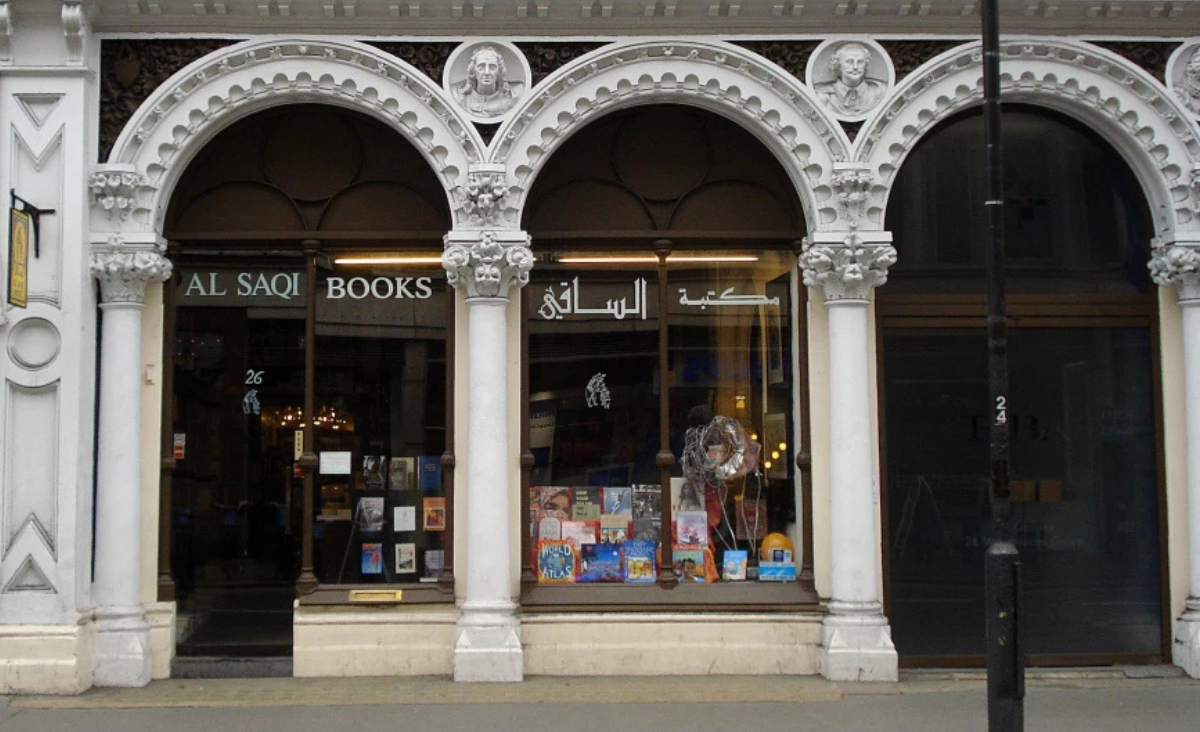
Photo: Al Saqi Books, Kake CC BY-NC-SA 2.0
Call for Papers “Arabic Publishing Beyond the Arabic-Speaking Areas: Field Reconfigurations, Crisis, and the Politics of Circulation”
Venue: Maison méditerranéenne des sciences humaines et sociales/Mmsh, Duby and Germaine Tillion Rooms, Aix-en-Provence (France).
Dates: 18 and 19 March 2027.
Organisers: Annamaria Bianco, Susanne Abou Ghaida, Antonio Pacifico and Jean-Christophe Peyssard.
Download the Call for Papers in English, French, and Arabic
From the first book printed in Arabic characters in 1514 in Fano, Italy—the Book of Hours published by the Gregori brothers (Balagna 1984)—to the new presses now established in Europe, Turkey and North America, Arabic publishing has long exceeded the geographical boundaries of the “Arabic-speaking areas”. 1 This historical trajectory has been further illuminated by recent research on early Arabic printing, including the ERC-funded TYPARABIC project (2019–2026), which examined cultural transfers between Eastern Europe and Arabic-speaking Christians in the Ottoman Near East (Dipratu and Noble 2024, Feodorov 2024, Negoiță and Feodorov 2026). 2
By foregrounding the role of transregional religious, intellectual, and technical networks in the production of Arabic books, such studies thus invite us to situate the flourishing nineteenth-century Arabic publishing within a broader and older history of circulation beyond the Arab region. With the beginnings of the Arab Awakening (al-Nahḍa), non-Arab cities emerged, indeed, as important centers for Arabic publications: Istanbul, Tehran, Paris, and London played a central role, but so did Bombay (Green 2011), Kazan (Kanlıdere 1997), Singapore and Java (Freitag 2003), Zanzibar (Ghazal 2010), as well as the Mahjar centers of New York, São Paulo, and Mexico (Pastor 2017, Mermier 2022a).
During the second half of the twentieth century, these transregional circuits were transformed by decolonization, the consolidation of authoritarian regimes in several Arab states, and successive wars, occupations and exiles. Paris became a major cultural center for intellectuals and writers from the Maghreb and the Levant, especially those fleeing the civil wars in Lebanon (Leonhardt-Santini 2006) and Algeria (Leperlier 2018). From the 1970s onwards, the United Kingdom became another focal point for exiles from Libya and the Mashreq. London emerged as both a capital of political exile and a center of a pan-Arab press whose influence continues to shape Arabic cultural production today, with institutions such as Banipal (partially relocated in Madrid), Saqi Books and Fergiani Publishing (Bendahan and Nader 2022, El-Ariss 2022). Iraqi refugees — political dissidents or Kurds — also created new publishing initiatives in the 1980s and 1990s in Germany and the Scandinavian countries (Al-Nawas 2017). During the Cold War, Moscow played in turn a major role as the capital of the “second world”, hosting students and intellectuals from across the Arab world (Djagalov 2020).
Over the past four decades, these transformations have intersected with a profound reconfiguration of Arabic cultural production inside the Arab world itself: what had long been structured around a relatively stable regional publishing system centered on Cairo, Beirut, and later the Gulf, has progressively evolved into a polycentric and transnational network (Mermier 2016b), within which the Maghreb and Iraq are also gradually (re)gaining prominence (Bianco 2026). This reconfiguration also resonates with recent work on Arab literary traditions as a global phenomenon (Hassan 2017).
This process has gained momentum since the uprisings of 2010–11. Repression, war, economic precarity, and large-scale displacement have not merely displaced writers and intellectuals; they have transformed the infrastructures that make literary life possible: publishing houses, bookstores, translation circuits, book fairs, residencies, cultural foundations, digital platforms (Bizri 2016), and funding mechanisms have all been reshaped by the effects of crisis and relocation, even giving rise to itinerant initiatives such as Maktabet Alarab or federative networks such as Safahat Publishing. New Arab cultural scenes have emerged in exile, while remaining closely connected to societies of origin through digital media, social networks, online magazines, remote collaborations, and transnational publics (i.e. Lang 2019, Sellman 2022, Almadhoun and Geist 2023, Mermier 2023). These scenes are also marked by the emergence of labels such “refugee”, “migrant” or “exile literature” as both a critical and market category; by growing dependence on fellowships and grants awarded by NGOs, along with European cultural institutions or pan-Arab foundations; and by the fragility of small publishing ventures operating between ethical commitment, professional precarity, and market constraint (Bianco, 2025; 2026).
Rather than treating crisis as an external interruption of cultural life, this conference approaches it as one of the conditions through which Arab cultural fields are reorganized. In this sense, the post-2011 moment confirms Richard Jacquemond and Felix Lang’s (2019) argument that disaster, catastrophe and structural emergency reshape Arab cultural fields from within, by redistributing positions, resources, and possibilities of circulation: the erosion of national institutions, the weakening of local cultural economies, and the multiplication of forced mobilities have not simply produced loss or fragmentation; they have also displaced literary activity toward new sites, new intermediaries, and new forms of competition and dependency. This vulnerability has been further deepened by successive shocks affecting the material conditions of publishing. The Beirut port explosion of 2020 struck one of the historical centers of Arabic publishing amid Lebanon’s broader economic and institutional collapse; the Covid-19 pandemic disrupted book fairs, supply chains, printing, and cultural programming, while accelerating digital circulation; the regional instability following Israel’s war on Gaza after 7 October 2023 has further exposed the fragility of cultural infrastructures and the geopolitical constraints faced by Arab publishers, writers and translators (Onorato and Murad 2026).
Consequently, Arabic-language publishing initiatives and book fairs have multiplied, across the old post-colonial centers of London and Paris, but also in new cities in Europe and beyond (Almadhoun and Geist 2023, Bianco 2026), such as Berlin (Khan Aljanub) — which has become an important hub for Arab cultural production (Bader and Samour 2023, Pannewick 2023) — Marseille (with Karkadé, Alifbata and Le port a jauni), Nancy (with the festival SALMA), Milan (Dār al-Mutawassiṭ), Plovdiv (Dar al-Darawech), Malmö (Dar Sameh), Copenhagen, Istanbul (Elhagin 2021), Chicago, Seattle, Montreal (with the Arab Canadian Book Fair), etc.. Recent Arabic-language discussions of publishers in the diaspora have similarly emphasized their role in strengthening the presence of Arabic language and culture in Europe, while also pointing to the practical obstacles they face: limited distribution, high printing and shipping costs, uneven access to readers, and the need to combine publishing with translation, fairs, and cultural programming (Al Jazeera 2024).
These enterprises are not simply contemporary versions of past émigré publishing (Mermier 2022). Rather, they have emerged from new historical conjunctures shaped by shifting migration routes, European asylum policies, Gulf petro-monarchies’ cultural diplomacy, digital platforms, and the growing presence of Arabic-speaking readerships outside the Arab region. In this context, publishing has become a privileged site from which to observe how literary spaces, inside and outside traditional centers, reorganize under conditions of crisis, relocation, and global competition (ʿAzab 2021).
One particularly revealing dimension of this reorganization is children’s publishing in the diaspora. By promoting either Standard Arabic or dialectal varieties, these often-small-scale initiatives 3 link literacy, cultural transmission, and debates on language register, while also highlighting shifting conceptions of Arabness between national specificity and transnational belonging. They also show that the issue of Arabic publishing abroad cannot be understood only through the geography of exile or the circulation of texts. It must also be approached through the concrete actors, practices, infrastructures, and material choices that make publishing possible: who publishes, for whom, with what resources, through which linguistic, editorial, economic, and institutional compromises. Such an approach also resonates with other on-going projects that place the material and social life of books at the center of analysis. For instance, the ANR project LIV-REL (2024-2028), devoted to the social life of religious books in the Maghreb and Mashreq, invites us to consider books not only as texts, but also as objects endowed with economic, moral, political, and symbolic value. 4
The present conference takes this articulation between field reconfiguration, transnational circulation, and editorial practice as its methodological point of departure, combining insights from anthropology of the books (Cohen 2016, Mermier 2016a, b, c; 2022), publishing (Thompson 2010) and migration studies (Mayblin & Turner 2020), as well as the sociology of literature (Bourdieu 1979, 1992; Casanova,1999 [2004]) and cultural intermediaries (Geroulanos & Sapiro 2024, Hauchecorne 2024), along with recent debates on world literature and linguistic areas of literature (Leperlier 2022).
The conference seeks to combine macro-level analysis of the Arabic publishing field with micro-level attention to actors, practices, and material gestures through which books are produced, circulated, and valued. It invites inquiry into the social trajectories of publishers, editors, translators, designers, booksellers, librarians, rights managers, festival organizers, and other cultural intermediaries; their professional training, cultural capital, networks, and forms of socialization into the craft of publishing; and their relations to writers, critics, funders, book fairs, libraries, and platforms. It also encourages attention to the materiality of editorial work, whose details participate in the production of value, authority, readability, and legitimacy.
Publishing houses founded outside the Arabic-speaking region are not peripheral anomalies: they are agents engaged in struggles. Positioned at the intersection of cultural and economic fields, they negotiate between autonomy and heteronomy, ethical posture and economic rationalization, professional ideals and material constraint. Relocation does not automatically produce symbolic centrality; it may instead expose publishers, writers, and intermediaries to new hierarchies, including dependence on metropolitan institutions, unequal translation flows, competitive grant systems, asymmetrical regimes of visibility, and new forms of professional vulnerability.
Foregrounding publishing as a strategic observatory of these transformations raises a set of interconnected questions. How are new centers of legitimacy constructed? How do diaspora publishers negotiate relationships with Gulf-sponsored prizes, fairs, and funding bodies? How do they navigate competition, fragmentation, and market volatility? How do publishers “convert” (Bourdieu, 1992) ethical positioning, dissent, or claims to independence into symbolic capital, visibility, and professional legitimacy? Who are the actors and intermediaries who make these circulations possible? How are editorial professions transformed by exile, digitalization, precarious funding, and transnational readerships? What kinds of publishing models (predatory, subsidized, cooperative, activist) emerge under these conditions? How do translation, rights management, book fairs, libraries, festivals, and digital platforms reshape the social life of Arabic books beyond traditional Arab centers?
We invite proposals from academics and professionals—including publishers, editors, translators, booksellers, librarians, designers, rights managers, cultural programmers, and book-fair or festival organizers—whose submissions are rooted in scholarly analysis, field research, institutional work, or hands-on professional experience. Joint proposals bringing together academic and professional perspectives are particularly welcome. Alongside traditional papers, we also invite roundtables, practitioner-led conversations, interviews, workshops, digital or platform walkthroughs, and other formats that highlight the infrastructures shaping editing, translation, rights, distribution, bookselling, libraries, festivals, and digital circulation.
Contributions may fit into one or more of the following axes:
Axis 1 – Reconfiguring the Field: Centers, Peripheries, and World Literary Hierarchies
This axis invites contributions that examine how Arabic publishing abroad challenges, reproduces, or renegotiates hierarchies within Arabic literary and cultural fields and the broader world literary system. Papers may address the shifting geography of consecration, the role of Gulf book fairs and international prizes, the emergence of new hubs, and the strategic positioning of diasporic publishers vis-à-vis Cairo, Beirut, the Gulf, the Maghreb, Iraq, and other historical or emerging centers. How do new publishing hubs accumulate legitimacy? Are we witnessing a multiplication of centers, or the displacement of peripheral struggles into new arenas?
Axis 2 – Actors, Professions, and Editorial Practices
This axis focuses on the actors, relationships, and practices that shape publishing. Contributions may address publishers, editors, translators, designers, booksellers, librarians, rights agents, festival organizers, and other cultural intermediaries; their professional trajectories and training; editorial decision-making; catalogue construction; and the material infrastructures through which books are produced, circulated, and valued. Particular attention may be given to the relationships between authors and publishers, understood not only from the perspective of editorial selection, commissioning, negotiation, and support, but also from that of writers’ strategies, expectations, constraints, and forms of agency within the publishing process. Contributions may thus examine how authors and publishers co-construct books and literary value, especially in contexts marked by exile, transnational circulation, precarious funding, or shifting readerships. The axis also welcomes analyses of paratext, metadata, rights management, digital tools, and platform work.
Axis 3 – Publishing as Strategy: Capital, Autonomy, and the Political Economy of Exile
This axis examines the concrete practices through which diasporic publishers accumulate, convert, and negotiate different forms of capital. Contributions may analyze editorial policies, translation strategies, copyright regimes, digital marketing, funding structures, distribution networks, author-publisher contracts, and models such as cooperative, activist, subsidized, predatory, or author-financed publishing. How does the claim to independence function as a form of symbolic differentiation? In what ways does dissent operate as both an ethical stance and a market distinction? How are autonomy and economic rationalization negotiated in structurally constrained environments?
Axis 4 – Translation, Mediation, and the Production of Transnational Literary Publics
Translation is not merely a technical operation but a mechanism of power that structures access to the world literary space. This axis examines how Arabic publishing abroad participates in shaping new literary publics. Papers may explore bilingual editions, Arabic-European translation flows, children’s publishing in diaspora contexts, library policies, grassroots initiatives, digital platforms, reading communities, festivals, and literary events. How do mediating institutions reconfigure the social life of the Arabic book? What new forms of readership and recognition emerge outside traditional Arab centers?
By bringing together all these different perspectives, the conference aims to move beyond celebratory narratives of globalization and beyond reductive accounts of crisis. It seeks, instead, to interrogate the structural and material transformations reshaping Arabic literary and cultural production at the intersection of displacement, market forces, digital mediation, professional labor, and global hierarchies of cultural value.
While a diachronic perspective is essential, the conference will focus primarily on the post-2011 landscape. Historical papers are nevertheless welcome when they help illuminate the longer genealogies of today’s transformations. We understand Arabic publishing in a broad but delimited sense: the conference gives priority to literary and cultural publishing—fiction, poetry, essays, children’s books, translation, criticism, and related cultural mediation—while also welcoming contributions on academic, political, or religious publishing when they shed light on the reconfiguration of Arabic literary and cultural fields beyond the Arabic-speaking world.
Submission Guidelines
Please submit a proposal in English, Arabic, or French including:
• An abstract of 300–400 words
• A short biography (100–150 words)
• Institutional affiliation (if applicable) / professional role and organization (if applicable)
• Mode of participation: physical
Please send proposals to annamaria.bianco[at]univ-amu.fr, antonio.pacifico[at]univ-lyon3.fr, ska00ster[at]gmail.com and jean-christophe.peyssard[at]univ-amu.fr
Please also indicate the format of your proposal:
• Individual paper: 20-minute presentation
• Roundtable: 60–90 minutes, 4–6 participants (including a moderator)
• Practitioner-led conversation: 60–90 minutes, 2–4 facilitators/presenters (discussion-oriented)
• Other/alternative format: interview or 1:1 conversation, curated reading/performance, live translation or editorial demo, digital/platform walkthrough, writing or publishing workflow. Please specify the proposed structure, duration (30–90 minutes), number of participants, and any technical or logistical requirements.
Deadline for submission of abstracts: 30 November 2026.
Decision about acceptance: 11 January 2027.
Papers may be submitted in English, Arabic, or French. However, to support accessibility and broad participation, the conference’s main working language—particularly for discussion and Q&A—will be English.
Selected papers may be considered for publication in a peer-reviewed edited volume or special issue.
Funding Opportunities
Participation in the conference is free of charge and lunches will be provided on site.
Travel and accommodation expenses may be covered, upon request, only in cases of justified need and subject to limited availability.
************
1 This expression is borrowed from Mermier 2022, who coined it to define the Arabic press published outside the Arabic-speaking areas while including all publications (dailies and periodicals) edited and published in Arabic in countries where this language is not the dominant one.
2 TYPARABIC, 2019–2026, Early Arabic Printing for the Arabic-Speaking Christians: Cultural Transfers between Eastern Europe and the Ottoman Near East in the 18th Century, ERC Advanced Grant, Grant Agreement No. 883219.
3 Initiatives such as Dar Lilei and LibLib Publishing in the United Kingdom, or Asfoura Books, Ossass-Stories, and Tuta Tuta in the United States of America are often small operations founded by Arab parents—frequently mothers—raising children in the diaspora.
4 ANR, 2024–2028, LIV-REL – La vie sociale des livres religieux au Maghreb-Mashrek, Projet ANR-24-CE41-3826.