HSMAU33 - Séminaire - Middle Eastern Historiographies (2026)
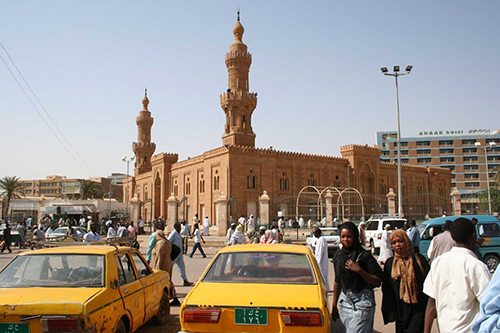
Photo : Khartoum © Iris Seri-Hersch, 2007
Séminaire d'enseignement du Master Langues et sociétés, parcours Moyen-Orient & Maghreb (MOMA) et projet TAMAM, Département d’études moyen-orientales, Aix-Marseille Université.
Lecturers : Martina Ambu, Norig Neveu, Iris Seri-Hersch
This seminar takes place on Mondays, 4-6 pm, at Mmsh, Aix-en-Provence, Ground Floor, Room 5. All interested master's students, PhD candidates, and scholars are welcome to attend. For more information and access to the weekly readings, please contact iris.seri-hersch[at]univ-amu.fr
Syllabus
September 14
Introduction (M. Ambu)
Readings
Rian Thum, “What is Islamic History?,” History and Theory, Vol. 57, 2019, p. 7-19.
Shahzad Bashir, “On Islamic Time: Rethinking Chronology in the Historiography of Muslim Societies,” History and Theory, Vol. 53, 2014, p. 519-544. Read p. 519-530.
September 21
The “Global Turn” in Medieval History: The Global Middle Ages and Islam (M. Ambu)
Required reading (*homework*)
Catherine Holmes and Naomi Standen, “Introduction: Towards a Global Middle Ages,” Past & Present, Vol. 238, 2018, p. 1-44. Read p. 4-28 (end of first paragraph).
Additional reading
Ian Forrest and Anne Haour, “Trust in Long-Distance Relationships, 1000-1600 CE,” Past & Present, Vol. 238, 2018, p. 190-213.
Video: Smail, Daniel Lord. “A Life in the Black Death: The Inventory of Alayseta Paula (Marseille, 1348),” Middle Ages for Educators, 1 April 2020.
September 28
A Look into a Recent Historiographical Endeavor in Mamluk Studies (M. Ambu)
Required reading (*homework*)
Jo Van Steenbergen et al., “Fifteenth-Century Arabic Historiography: Introducing a New Research Agenda for Authors, Texts and Contexts,” Mamluk Studies Review, Vol. 23, 2020, p. 33-61.
Additional reading
Perrine Pilette, “Transforming the Coptic Ecclesiastical History at the Beginning of the Mamluk Period: From the History of the Patriarchs of Alexandria to the Coptic-Arabic Synaxarion,” Annales Islamologiques, Vol. 58, 2024, p.11-29.
October 5
An Anthropology of Islam (M. Ambu)
Required reading (*homework*)
Talal Asad, “The Idea of an Anthropology of Islam,” Occasional Papers Series, Center for Contemporary Arab Studies, Georgetown University, March 1986, p. 1-22.
October 12
A Single (European) Modernity or Multiple Modernities? (I. Seri-Hersch)
Required reading (*homework*)
Dror Ze’evi, “Back to Napoleon? Thoughts on the Beginning of the Modern Era in the Middle East,” Mediterranean Historical Review, Vol. 19(1), 2004, p. 73-94.
Additional reading
Olivier Bouquet, “Is it Time to Stop Speaking about Ottoman Modernisation?” in Olivier Bouquet et al., eds. Order and Compromise: Government Practices in Turkey from the Late Ottoman Empire to the Early 21st Century. Leiden: Brill, 2015, p. 45-67.
Podcast: “The Middle Class in the Modern Middle East, with Keith David Watenpaugh,” Ottoman History Podcast, 7 April 2016.
October 19
Local Archives, Colonialism, and Knowledge/Power Dialectics (I. Seri-Hersch)
Required reading (*homework*)
Omnia El Shakry, “‘History without Documents’: The Vexed Archives of Decolonization in the Middle East,” The American Historical Review, Vol. 120(3), 2015, p. 920-934.
Additional reading
Mahassin Abdul Jalil, “From the Terraces of Celebrated Narratives to the Cellars of Tarnished History: Obliterating Knowledge in Sudanese and Arab Historiography” in Elena Vezzadini et al., eds. Ordinary Sudan, 1504-2019: From Social History to Politics from Below. Berlin: De Gruyter, 2023, p. 87-117.
Podcast: “The Politics of 1948 in Israeli Archives, with Shay Hazkani,” Ottoman History Podcast, 18 July 2014.
October 26: holiday - no class
November 2
The Arab Uprisings (2011-2021): A Series of Revolutions? (I. Seri-Hersch)
Required reading (*homework*)
Gianni Del Panta, “The Revolutionary Character of the ‘Arab Revolutions’ and How They Could be Studied,” Partecipazione e Conflitto, Vol. 14(2), 2021, p. 760-773.
Additional reading
Asef Bayat, “The Arab Spring and Revolutionary Theory: An Intervention in a Debate,” Journal of Historical Sociology, Vol. 34(2), 2021, p. 393-400.
Podcast: “Disillusionment in Morocco’s February 20 Movement, with Taieb Belghazi & Abdelhay Mouden,” Ottoman History Podcast, 26 January 2018.
November 9
The Nexus of Sectarianism and Gender in the Middle East (I. Seri-Hersch)
Required reading (*homework*)
Raha Aldoughli, “Missing Gender: Conceptual Limitations in the Debate on ‘Sectarianism’ in the Middle East,” Middle East Critique, Vol. 33(1), 2024, p. 143-162.
Podcast: “Rethinking Sectarianism in the Middle East, with Ussama Makdisi,” Ottoman History Podcast, 12 September 2015.
November 16
Orientalism and Ottoman Orientalism (N. Neveu)
Required reading (*homework*)
Ussama Makdisi, “Ottoman Orientalism,” American Historical Review, Vol. 107(3), 2002, p. 768-796.
Additional reading
Edward Said, Orientalism. Introduction, Routledge & Kegan Paul Ltd., 1978. p. 9-38.
November 23
The Household, Politics of Notables, and Historigraphical Debates on Social Mobilization (N. Neveu)
Required reading (*homework*)
James L. Gelvin, “The Social Origins of Popular Nationalism in Syria: Evidence for a New Framework,” International Journal of Middle East Studies, Vol. 26, 1994, p. 645-661.
Additional reading
Albert Hourani, 1968, “Ottoman Reform and the Politics of Notables,” in William R. Polk and Richard L. Chambers (eds.), Beginnings of Modernization in the Middle East, Chicago, University of Chicago Press, 1968, p. 41-68.
November 30
Imperial History and Colonial Dynamics: The Middle Eastern Mandates between Expertise and Developmentalism (N. Neveu).
Required reading (*homework*)
Simon Jackson, “‘What is Syria Worth?’ The ‘Huvelin Mission’: Economic Morality and the French Imperial Project in the Mashriq, 1918‑1922,” in Emmanuelle Sibeud, Hélène Blais & Claire Fredj (eds.), Sociétés coloniales. Enquêtes et expertises, special issue Monde(s). Histoire espaces relations, no 4, 2013, p. 83‑103.
Additional reading
Susan Pedersen, “The Meaning of the Mandates System: An Argument,” Geschichte und Gesellschaft, 32. Jahrg., H. 4, Sozialpolitik transnational, 2006, p. 560-582.
December 7
Borders, Migration, and State Formation: Regimes of Mobility in the Modern Middle East (N. Neveu)
Required reading (*homework*)
Lauren Banko, “Border Transgession, Borders Controls: Mobility along Palestine’s Northern Frontier, 1930-1946,” in Jordi Tejel and Ramazan Hakki Öztan (eds.), Regimes of Mobility, Borders and State Formation in the Middle East, 1918-1946, Edinburgh, Edinburgh University Press, 2022, p. 256-285.
Additional reading
Liat Kozma, Cyrus Schayegh & Avner Wishnitzer, “Introduction,” in Liat Kozma, Cyrus Schayegh & Avner Wishnitzer (eds.), A Global Middle East: Mobility, Materiality and Culture in the Modern Age, 1880-1940, London, I.B. Tauris, 2014, p. 1-15.