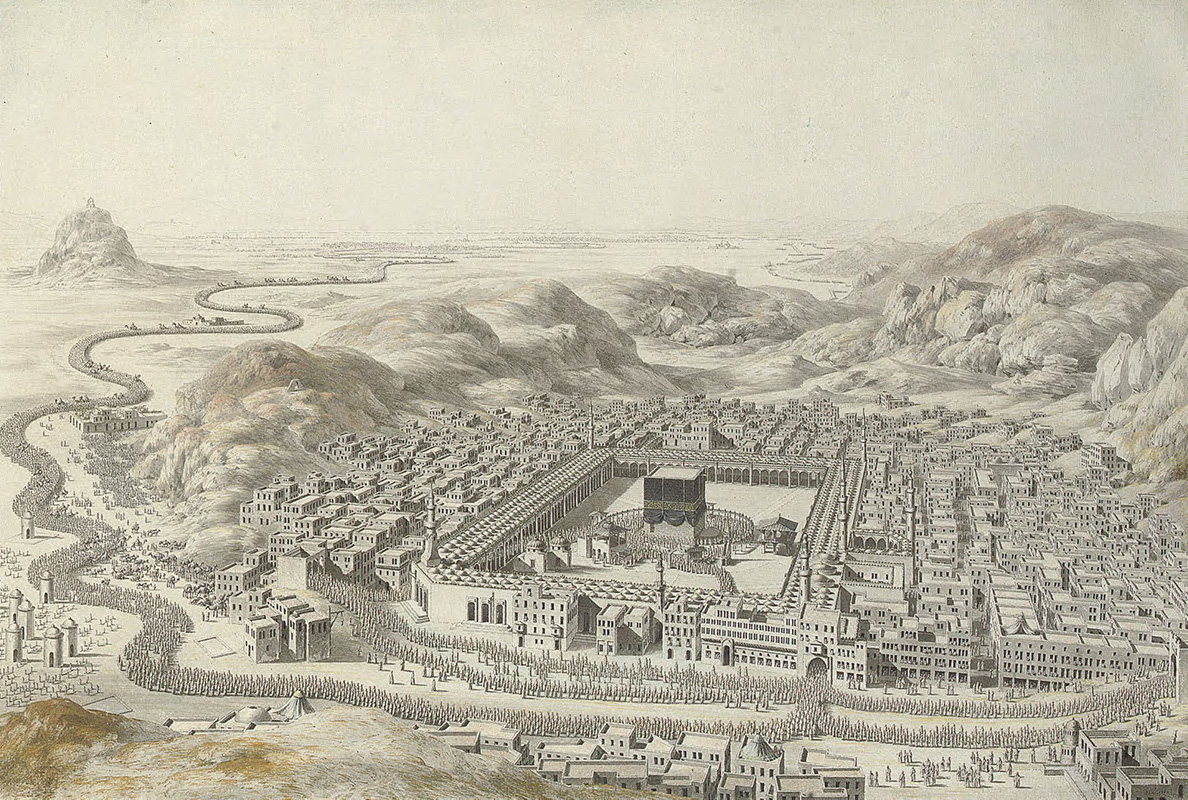
Photo : Mecca, Louis-Nicolas de Lespinasse, Wikimédia
Séminaire - Approches plurielles des études islamologiques avec Kader SMAIL
Jeudi 9 avril 2026, 14h00-18h00, Mmsh, salle Germaine Tillion, Aix-en-Provence.
La Mecque dans les premiers siècles de l’islam : écrire l’histoire, construire le sacré et exercer le pouvoir
Cette intervention propose d’interroger les modalités de formation de La Mecque aux premiers siècles de l’islam en la considérant comme un espace à la fois historicisé, sacralisé et investi par le pouvoir. Il s’agira moins d’en présupposer la centralité que d’examiner les conditions dans lesquelles elle est progressivement constituée comme un espace central.
Un premier temps portera sur son histoire et les difficultés qu’elle pose, les informations disponibles dans le Qurʾān étant limitées, tandis que l’essentiel des données dont nous disposons provient de sources narratives postérieures à l’émergence de l’islam. Il s’agira d’examiner ce décalage et ce qu’il implique pour l’écriture du passé mecquois. Un deuxième temps sera consacré à la construction du sacré. On s’appuiera, entre autres sources, sur l’épître attribué à Ḥasan al-Baṣrī (m. ca. 110/728) sur les mérites de La Mecque, pour examiner comment ce document élabore l’un des premiers discours sur la sainteté du lieu et les valeurs qui lui sont attachées. Enfin, on abordera les enjeux de pouvoir liés à cet espace, en examinant le contrôle califal de la ville, les situations de conflit qu’il suscite, ainsi que le rôle des acteurs locaux, savants et mujāwirūn (résidents dévotionnels), dans la négociation et la reproduction de l’autorité sur le lieu saint.
L’ensemble vise à montrer que cet espace se constitue, dans les premiers siècles de l’islam, à l’intersection de l’écriture de son passé, de sa qualification comme espace sacré et des usages politiques dont il fait l’objet.
Kader SMAIL est historien du Moyen-Orient médiéval, spécialiste de l’islam des premiers siècles et de la formation de La Mecque comme espace sacré. Il a soutenu en 2025 une thèse intitulée Constructing Mecca’s Sanctity: Scholars, Caliphs, and the Making of a Sacred Center à l’University of Maryland, sous la direction d’Antoine Borrut, consacrée aux processus historiques par lesquels La Mecque s’est imposée comme centre sacré dans les premiers siècles de l’islam. Lauréat de l’appel « Contrat postdoctoral – édition et traduction commentée » de l’Institut français d’islamologie, il est actuellement chercheur postdoctoral à l’Institut de recherches et d’études sur les mondes arabes et musulmans (Aix-en-Provence). Il y travaille à la traduction et à l’étude de l’épître Faḍāʾil Makka, attribuée à al-Ḥasan al-Baṣrī (m. ca. 110/728), consacrée aux mérites de La Mecque. Ses recherches portent plus largement sur les pratiques dévotionnelles, la formation des espaces sacrés et les relations entre autorité religieuse, pratiques rituelles et organisation de l’espace dans les sociétés musulmanes des premiers siècles.
Seminar - Plural approaches to Islamic Studies With Kader SMAIL
Mecca in the Early Centuries of Islam: Writing History, Constructing Sanctity, and Exercising Power
This talk examines the formation of Mecca in the early centuries of Islam, approaching it as a space that is simultaneously historicized, sacralized, and invested with power. Rather than presupposing its centrality, it explores the conditions under which that centrality was progressively defined.
The first part addresses Mecca’s history and the challenges it poses. The Qurʾān provides limited information about the city, while most available data derives from narrative sources postdating the emergence of Islam. This gap and its implications for the writing of Mecca’s past will be examined. The second part focuses on the construction of sanctity. Drawing, among other sources, on the epistle attributed to Ḥasan al-Baṣrī (d. ca. 110/728) on the merits of Mecca, it examines how this document elaborates one of the earliest discourses on the city’s sanctity and the values attached to it. Finally, the third part turns to the politics of sacred space, examining caliphal control over the city, the conflicts it generated, and the role of local actors, scholars, and mujāwirūn (devotional residents), in negotiating and reproducing authority over the holy site.
This threefold approach suggests that Mecca, in the early centuries of Islam, emerged at the intersection of historical writing, the construction of sanctity, and the political uses to which it was put.
Kader SMAIL is a historian of the medieval Middle East, specializing in early Islam and the formation of Mecca as a sacred space. He completed his PhD in 2025 at the University of Maryland under the supervision of Antoine Borrut, with a dissertation entitled Constructing Mecca’s Sanctity: Scholars, Caliphs, and the Making of a Sacred Center, which examines the historical processes through which Mecca established itself as a sacred center in the early centuries of Islam. A recipient of the “Postdoctoral Fellowship in Scholarly Edition and Translation” awarded by the Institut français d’islamologie, he is currently a postdoctoral researcher at the Institut de recherches et d’études sur les mondes arabes et musulmans (Aix-en-Provence). He is working on the translation and study of the epistle Faḍāʾil Makka, attributed to al-Ḥasan al-Baṣrī (d. ca. 110/728), on the merits of Mecca. His research addresses more broadly devotional practices, the formation of sacred spaces, and the relationships between religious authority, ritual practice, and the organization of space in early Muslim societies.