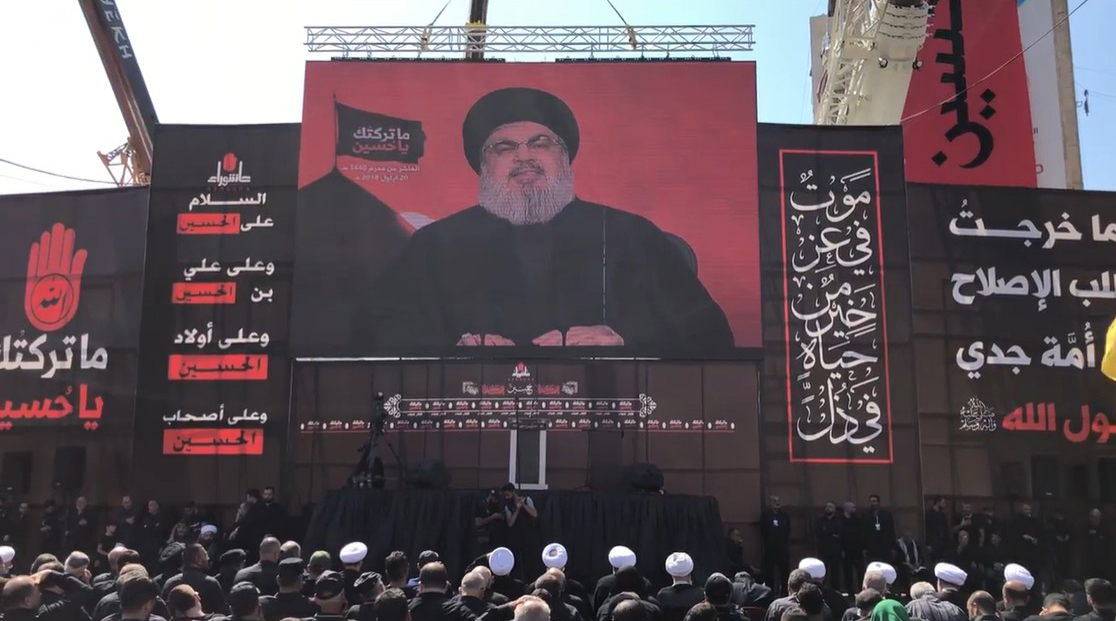
Photo prise à Dahye par N. Smrekar le 20 septembre 2018 lors du discours de l'Achoura
Séminaire PredicMO
Séminaire mensuel de PredicMO - Grammaires de la prédication : lexique, cartographie, mise en scène (Moyen-Orient, XIXe-XXIe siècles)
Lundi 27 avril 2026, 13h00-15h00, Mmsh, salle 101 et en visioconférence. Lien Zoom / ID de réunion : 840 9981 2002 / Code secret : 246063
Neil Russell (Glasgow Caledonian University) et Natalie Smrekar (Ifpo) viendront présenter leurs recherches sur les sermons en Égypte et au Liban contemporains.
- Neil Russell (Glasgow Caledonian University), “The Politics of Preaching: Islamic Sermons and Religious Legitimation in Egypt”.
Since the 2011 Arab Uprisings, religious legitimation has increasingly been used as a strategy of authoritarian adaptation. In Egypt after the 2013 coup, the government nationalised thousands of private mosques, revoked the licences of independent preacher training institutes, and standardised the topic and content of Friday sermons. This research examines the ways official Islamic sermons contribute to the construction of religious legitimacy for authoritarian regimes, by analysing a corpus of 550 official Islamic sermons disseminated by the Egyptian Ministry of Awqaf since 2014. Official sermons instrumentalise religious discourse and construct an idealised national identity based on religious nationalism. Their use ranges from supporting major state projects, dissuading behaviours seen as threatening to societal stability, and promoting a state feminism fusing women’s empowerment with family responsibility, and service to the nation. This analysis comprises part of a larger mixed-method project, combining quantitative text analysis, text reuse detection, and survey data, to evaluate how state domination of the religious sphere aims to sustains authoritarian resilience in the contemporary Middle East.
Neil Russell is a Lecturer in Politics at Glasgow Caledonian University, having completed his PhD in Islamic and Middle Eastern Studies at the University of Edinburgh. His research lies at the intersection of studies on Islamism and authoritarianism, with a particular focus on Egypt, publishing in the Democratization journal. His first book, titled Islam and Authoritarianism in Egypt: The Transformation of Islamic Institutions after 2011, is under contract with I.B. Tauris – Bloomsbury, while he is also editing a volume on official Islam in the Middle East and North Africa. His current project applies Arabic NLP to a corpus of official Islamic sermons in Egypt, supported by a BA/Leverhulme Small Research Grant and POMEPS Travel Grant.
- Natalie Smrekar (Ifpo), “Preaching and Lexicon in Contemporary Shiite Discourse in Lebanon”.
This paper investigates the language of preaching in the speeches of Hassan Nasrallah, which are treated as an important example of Shiite political discourse in Lebanon. It also compares his speeches with those of other contemporary Shiite speakers. Using a Weberian approach to charismatic authority, the paper is less concerned with the linguistic forms that give these speeches legitimacy, build an image of the speaker as a guide, and create a shared community of interpretation. The linguistic analysis focuses on several recurring elements: quotations from the Qur’an, references to Karbala, and vocabularies of injustice, sacrifice, and commitment. It also examines a polarized style of language built around the contrast between a collective we and opposing figures. These features are not simply rhetorical devices. They help make sense of the present by linking contemporary conflicts to a shared Shiite memory and to a common moral and religious framework. The case of Nasrallah makes it possible to identify broader mechanisms of contemporary Shiite preaching, while also opening the way for comparison with other speakers. In this way, the paper reflects on the role of language in legitimation, mobilization, and the formation of communities. The power of this discourse does not depend only on the speaker’s status, but also on linguistic processes of framing, naming, and reinterpreting meaning, through which religion shapes collective identity.
Natalie Smrekar holds a PhD in Linguistics from Université Grenoble Alpes and is an associate researcher at the Ifpo. Arabic sociolinguistics and Critical Discourse Analysis (CDA) are among her main research interests. Within the framework of PredicMO, she focuses on the discourses of Shiite spiritual leaders in Lebanon, with particular attention to the lexicon employed and the connections between religion, politics, and power. This study aims to understand religious rhetoric as both a reflection of political dynamics and a tool used to legitimize power.