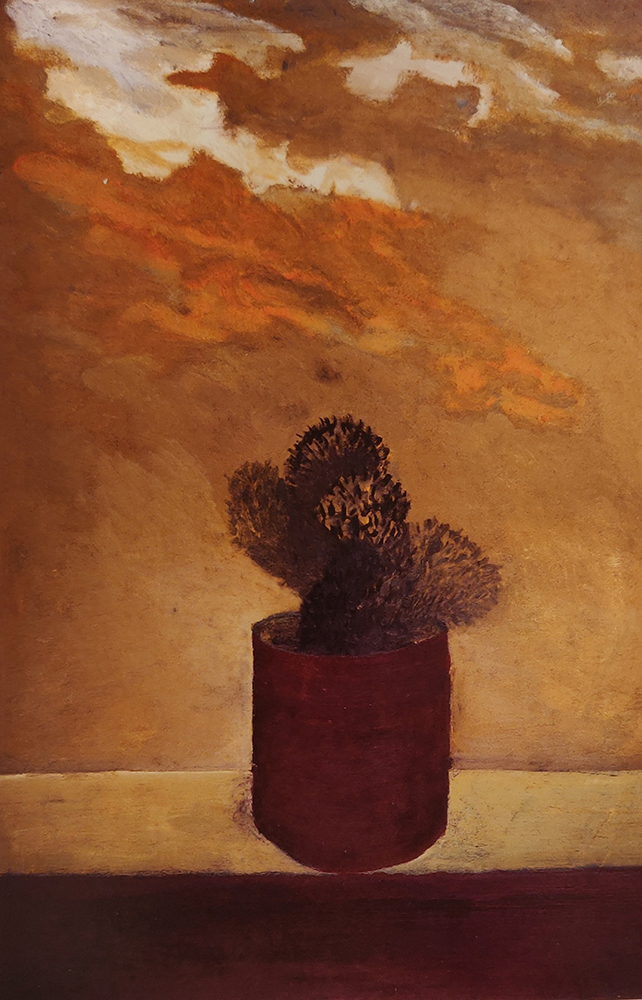
Photo : Asim Abu Shakra, prickly pear cactus, 100/70 cm, oil on cardboard, 1989 © Um el Fahem Contemporary Art Gallery. Reproduced with the artist's authorisation
Palestinian Culture Against the Grain - Séminaire avec Ahmad H. Sa’di
Responsables du séminaire : Thomas Pierret et Marine Poirier
Mardi 2 juin 2026, à 14h00, à la Mmsh (Aix-en-Provence), en salle A219, le séminaire de recherche de l'équipe Sciences sociales du contemporain accueillera Ahmad H. Sa’di pour une intervention intitulée “Cultural against the grain: Palestinians’ representation of alienation, rootedness, and death”.
La séance, en anglais, se déroulera également en visioconférence : lien Zoom / ID de réunion : 817 1945 5334 / Code secret : 823783
The colossal death in Gaza, which has in large part been transmitted live worldwide, forced viewers to conceptualize their positions regarding it, underscoring their moral responsibilities and depriving them of the shady moral leeway of the pretenses of ignorance or vagueness. Undoubtedly, the war in Gaza represents a new scale in the intensity of killing. However, death, in its biological and social forms, has been imposed on Palestinians’ consciousness since the Nakba in ways that I think are unique. Death for many Palestinians does not signal the end of life, since life has not been properly lived, or that the horrors of death are often indistinguishable from those of life. The stories of Kanafani – particularly Men in the Sun - and Shibli’s – Minor Detail – in this regard, constitute a pale version of the reality that many children in Gaza, whose limbs were amputated or who lost their families, endure. But do the depressing lives of Palestinians lead them to alienation and self-alienation? It often does, as for example, the work of Muna Hatoum shows. However, the theory of alienation, as developed by a long chain of scholars from Axel Honneth down to Marx and Hegel, could not explain how Palestinians sustained a spirit of liberation despite their repeated setbacks, the odds they face, and the dwindling of progressive politics worldwide.
The presentation will thus dwell on questions pertaining to death, alienation, and the consciousness maps of liberation in the Palestinian context by analysing Palestinian cultural products, including novels, films, and paintings.
Ahmad H. Sa’di is a Palestinian social scientist. He has taught and served as a visiting professor at several universities, including Ben-Gurion University, Israel; Waseda University, Tokyo, Japan; The National University of Singapore; Columbia University, New York; the College of Social Science and Humanities at the Ruhr Alliance universities, Essen University, Germany; and the University of Toronto, Canada. Throughout his career, he has published over fifty peer-reviewed articles and chapters, as well as three books. His research has been published in eight languages, including English (the primary language), Japanese, and German.
His areas of interest include collective memory; surveillance, population management and political control; political sociology; history of ideas; the Global South since independence; colonialism/postcolonialism; Israel/Palestine, as well as consciousness evolution and its articulation in culture. He is currently working on a monograph that focuses on Palestinian culture.
Selected publications
Sa'di A. H, Abu-Lughod L. (eds). 2007. Nakba: Palestine, 1948 and the Claims of Memory. New York: Columbia University Press.
Sa'di A H. 2014. Thorough Surveillance: The Genesis of Israeli Policies of Population Management, Surveillance & Political Control towards the Palestinians. Manchester: Manchester University Press.
Sa'di A. H, & Masalha, N. (eds). 2023. Decolonizing the Study of Palestine: Indigenous Perspectives and Settler Colonialism after Elia Zureik. London: I.B. Tauris.
Sa’di A H. 2021. ”Orientalism in a globalised world: Said in the 21st century”. Third World Quarterly. 24 (11): 2505-2520.
Sa’di A H. 2021. ”Israel’s settler-colonialism as a global security paradigm”. Race & Class. 63 (2): 21-37.
Sa’di A H. 2022. ”Arts in Dark Times: on goodness and thorniness of Palestinians under Israeli rule”. Third Text. 36 (4): 311-330.
Sa’di A H. 2025. ”Democracy as a utopia and democracy as a tool of domination: the structural roles of race, class, and coloniality in Western democratic regimes”. Politikon. 52 (1): 81-98.
Lien vers l'évènement Facebook / Consulter le programme complet du séminaire (2026)