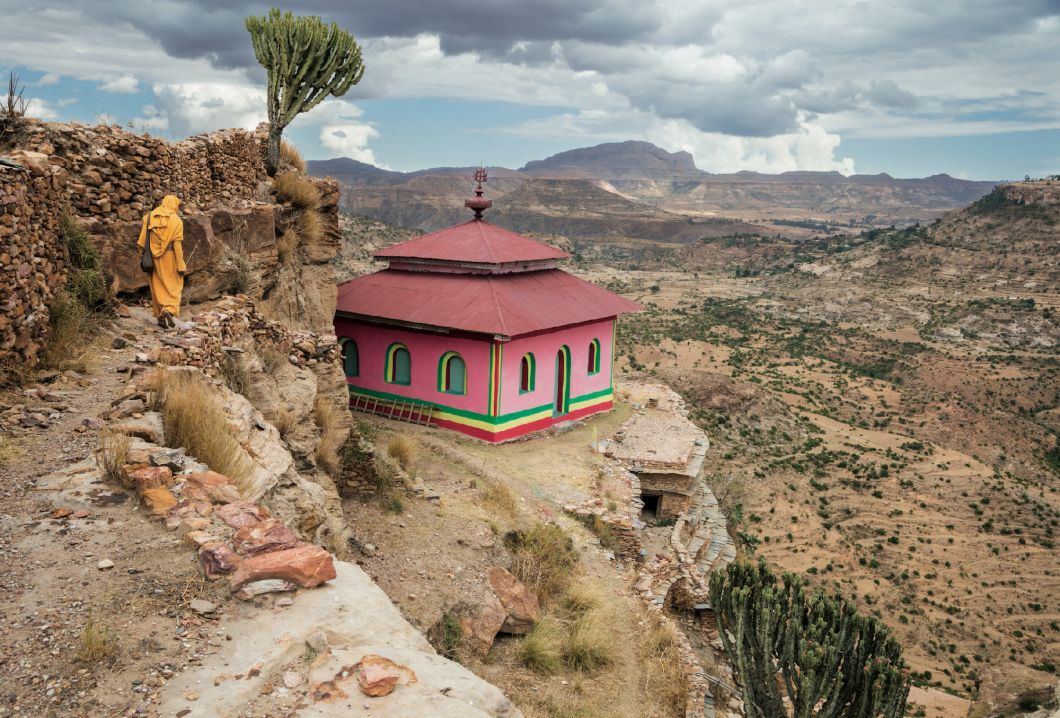
Photo : nouvelle église Debre Damo, Éthiopie, Nigel Pavitt, Frédéric Courbet et Justus Mulinge @ The American University in Cairo Press
Séminaire « Monuments et documents de l’Afrique ancienne : recherches en cours en histoire, histoire de l’art et archéologie »
Séminaire coordonné par Claire Bosc-Tiessé, référente (directrice d’études, EHESS - directrice de recherche, CNRS/IMAF) et Anaïs Wion (directrice de recherche, CNRS/IMAF). Avec la collaboration de Marie-Laure Derat (CNRS/Orient & Méditerranée) et Amélie Chekroun (CNRS/IREMAM).
Vendredi 29 mai 2026, 14h30-16h30, Campus Condorcet-Centre de colloques, salle 3.08, Aubervilliers et en visioconférence (lien Zoom envoyé sur demande à claire.bosc-tiesse[at]ehess.fr ; anais.wion[at]univ-paris1.fr).
Adrian Anagnost (Tulane University, professeure invitée EHESS), « Framing Benin City: European Visions of Edo Territorialization »
This lecture examines spatial and material histories of the Benin Kingdom through European representations of its art and architecture. Drawing from early modern European travel accounts, engravings, and later colonial imagery, I explore how Benin’s built environment—its palaces, walls, and public spaces—was interpreted, misrepresented, and appropriated in European visual culture. How did these depictions shape colonial imaginaries of Africa ? And how do they contrast with local spatial practices and aesthetic traditions ? By reconsidering these images alongside Benin’s own artistic and architectural legacies, this talk interrogates the dynamics of perception, instability, and iteration in the visual record of African polities.
En savoir plus sur le séminaire et consulter le programme complet 2025 - 2026 / À retrouver sur le site de l'Imaf et sur néobab